
What Walgreens taught us about “location, location, location”
Summary
- A net lease is not a bond. Walgreens properties were bought for the credit and the lease term, and their values fell when confidence in that income changed, though the real estate itself never did.
- Great corners get a second life. We redeveloped a former Walgreens in Murphy, Texas into a multi-tenant center and sold it this month, and gas station operators have backfilled other corners in our portfolio.
- Evaluate the dirt before the tenant. Three physical characteristics matter most: the size and layout of the lot, access and proximity to a traffic signal, and the zoning and restrictions that govern its use.
This month we sold a strip center in Murphy, Texas, outside Dallas. Six years ago, the property was a built-to-suit Walgreens. We bought it from a passive owner who, as I remember the broker telling me, had bought for the same reason most drugstore buyers do, a national name with a long lease and a rent check that showed up without a reminder. For years he owned something that behaved like a bond. Then the lease ran down, Walgreens let it be known it wasn’t going to renew, and the bond was about to turn back into a building. He faced the question every owner of a single tenant property eventually has to answer: what do I own once the tenant is gone?
We bought the property knowing the status of the lease, because we had a different answer to that question. Everybody in the real estate business can recite “location, location, location,” usually with an eye roll. But our evaluation of any property starts with the dirt, for exactly this reason. Tenants come and go, but a good corner never moves. The seller was parting with an expiring lease, or in his mind maybe an expiring bond. We were buying the dirt.
Riding High
At its peak, Walgreens opened a new store every 17 hours. It went from 4,250 stores in 2003 to 7,000 in 2009.1 And for a long time, nobody did it better. Jim Collins made the company one of the heroes of his book Good to Great, contrasting it with Eckerd Drug.2 Collins wrote that Walgreens had a simple idea during this growth cycle: to focus relentlessly on building the most convenient drugstore network in the country. That meant the highest trafficked corners, with multiple points of access and large parking fields. Collins noted (and I can confirm from my own experience with the company) that Walgreens would close a profitable store to take a better corner half a block away, even when it cost $1 million to get out of the old lease.
Walgreens carried an investment grade credit rating and offered property owners 25 years of firm lease term, and its net lease became the closest thing our business had to a bond. For decades, these leases ranked among the most desirable retail assets in net lease.3 They were so popular that many buyers never walked the site before purchasing. As late as 2015, GlobeSt noted that drugstore investors were “more focused on the underlying credit and lease term rather than location.”4
What Changed
And then things changed. With the threat of online shopping and home delivery growing rapidly in the 2010s, Walgreens stopped being a company that grew by finding the next great corner and became one that grew by acquisition. It merged with Europe’s Alliance Boots and later pushed into primary care clinics. Meanwhile, the ground shifted under the drugstore itself. Insurers and pharmacy benefit managers squeezed what a pharmacy gets paid to fill a prescription, front end competitors both online and brick and mortar took market share, and health care in general reorganized faster than a chain of 8,000 boxes could follow. The result is well known by now. A company worth more than $100 billion in 2015 was sold to a private equity firm last year for about $10 billion, after announcing plans to close some 1,200 stores.5
For investors who own drugstore real estate, the repricing has been severe. The median Walgreens property now asks an 8.10% cap rate,6 and in our own data set that represents an increase of more than 200 basis points in only five years. Holding rent constant, a move of that size reduces value by roughly a quarter. What makes this instructive is that nothing about the property itself changed. The rent is the same, the building is the same and the corner is the same. What changed was the market’s confidence in the income stream, specifically the credit behind the lease and the years remaining on it. Because these assets had been priced almost entirely on that income stream, the value of the real estate fell with it. A bond is a claim on a borrower’s promise to pay. A net leased drugstore was always something else: a parcel of land with a lease attached, and the lease, at least for now, has proven to be the less durable of the two.
The Corner Didn’t Leave
Here’s the part that gets lost in the headlines. For decades Walgreens picked real estate about as well as anyone, and even as it shrinks its fleet, it’s leaving behind a lot of great corners. Not all of them, of course. Matthews Real Estate found that about 52% of the stores closed over the past five-plus years are still sitting vacant, with nearly a quarter of the closures being former Rite Aids, which Walgreens acquired through acquisition.7 So the question for an owner isn’t whether Walgreens is staying. It’s do you have the kind of corner with second life potential? Investors who bought sight unseen are now asking that for the first time.
Second Lives
We bought the Walgreens property in Murphy I mentioned in September 2020. We loved it for many reasons, but a few stand out. It sat at a hard corner with a traffic light and several points of access, the main road carried almost 50,000 cars a day, and the site was in a dense retail corridor with little vacancy. We also liked that it served as an outparcel to the area’s only Walmart Supercenter. There were no underlying land use restrictions, and the local jurisdiction was very supportive of our redevelopment ideas. And who doesn’t love Texas, right?
Not long after Walgreens vacated, we secured leases with three national tenants and built a 9,000 square foot retail center with an end cap drive-thru. This month we sold the center to a publicly traded REIT. What had been a vacant drugstore with an expired lease is now a multi-tenant property with institutional ownership, and the only thing the two have in common is the quality of the corner.
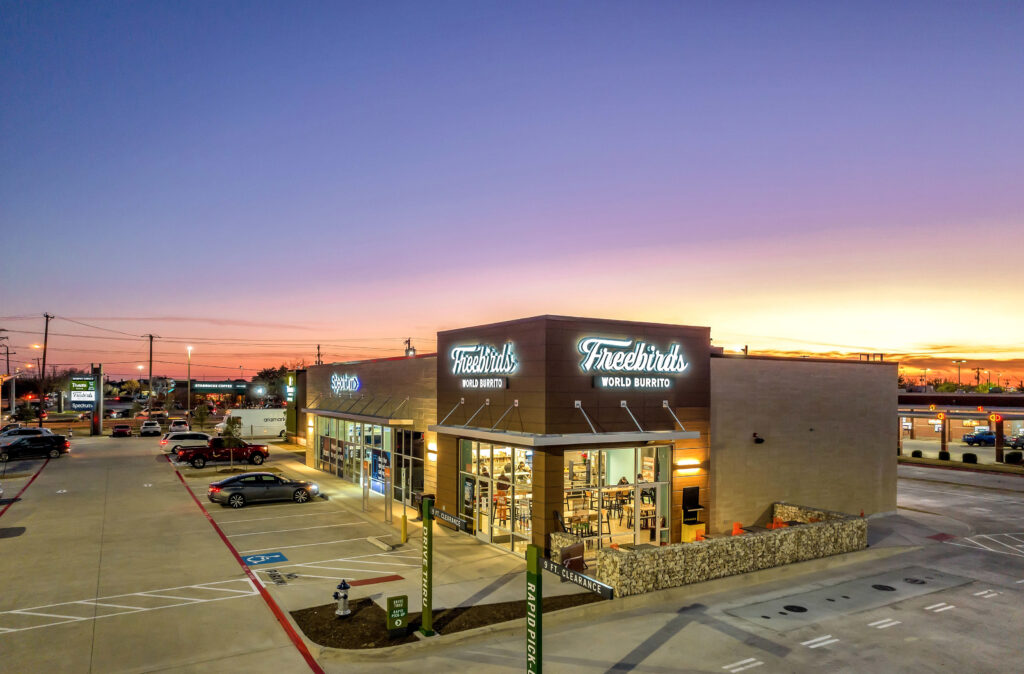
Murphy Corners in Murphy, Texas, on the site of the former Walgreens.
Gas station convenience stores have been another strong source of tenants for former Walgreens sites, because they pay for the same things Walgreens once did: the corner, the signal and the access. We’ve had the pleasure of working with Sheetz, RaceTrac, Wawa and Murphy USA on these assets in our portfolio. Last year, in fact, we bought a closed Walgreens in Richmond, Virginia directly from the company, took the building down and ground leased the site to Sheetz. We love this repositioning strategy, and it all starts with great corners.
Dirt First
None of this is a knock on Walgreens (whose real estate personnel I have known for many years and greatly admire) or any build-to-suit tenant for that matter. Nor am I suggesting that there is a simple solution for all vacant boxes. Plenty of former drugstores sit on sites where nothing we did in Murphy or Richmond would have worked. But that is my point. The difference between the two outcomes was discernable on the day the property was bought, to anyone who looked. So, whether you are an active developer or a passive investor, experienced or buying your first property, look to the dirt before you evaluate the tenant. Beyond the quality of the submarket and associated demographics, three physical characteristics matter most in our view.
The first is size and layout. A parcel has to be large enough, and regular enough in shape, to hold something other than the building that sits on it today. Murphy could take a multi-tenant building with a drive-thru lane. Richmond could take fuel pumps, a canopy and a store.
The second is access, and in particular proximity to a traffic signal. Signalized access from more than one direction is what the next tenant will pay for, and it is nearly impossible to add after the fact.
The third is what you are allowed to do with the land. Zoning, deed restrictions and recorded agreements decide how many of the possible replacement tenants are actually permitted. The fewer the limits, the more options you will have for your corner after the first tenant.
They say “location” three times for a reason. I’d argue those are the three for retail real estate: the lot, the access and the rules that govern it. None of this requires a developer’s experience. It requires asking, before the lease is ever read, what the property would be worth to the next tenant, because over a long enough holding period there will almost always be a next tenant. And always remember, you are buying dirt, not a bond.
References
Cited in text
1. Wagner, Mark, and Wayne Orvis. “Changing Structures and Behaviors at Walgreens.” strategy+business, Issue 72, Autumn 2013. August 27, 2013. https://www.strategy-business.com/article/00195
2. Collins, Jim. Good to Great: Why Some Companies Make the Leap…and Others Don’t. HarperBusiness, 2001. Chapter 5, “The Hedgehog Concept,” pages 91–94.
3. “Will Walgreens Closures Impact Net Lease Sector?” WealthManagement.com, April 23, 2015. https://www.wealthmanagement.com/real-estate/will-walgreens-closures-impact-net-lease-sector-
4. “Local Drug Stores Bringing in Investors.” GlobeSt, May 14, 2015. https://www.globest.com/2015/05/14/local-drug-stores-bringing-in-investors
5. “Walgreens to go private in roughly $10 billion deal with Sycamore Partners.” CNBC, March 6, 2025. “Sycamore Partners finishes deal to take drugstore chain Walgreens private.” Associated Press, August 28, 2025.
6. The Boulder Group, net lease research, first quarter 2026 (median asking cap rates), as reported by InvestmentGrade.com. https://investmentgrade.com/investment-grade-net-lease-cap-rates-q1-2026/
7. Matthews Real Estate Investment Services. “The Real Story Behind Walgreens Closures.” Undated market insight; analysis of the most recent 700 closures. https://matthews.com/the-real-story-behind-walgreens-closures-market-insight
Market and company data referenced
Change in Walgreens cap rates over five years. Morgan Company internal data set of drugstore net lease transactions.
Murphy Corners acquisition, redevelopment and sale; traffic counts. Morgan Company records and marketing materials.
